
Table of Contents
Feeling stuck on the couch while your to-do list piles up is a universal human experience. You want to execute your goals, but an invisible weight holds you back, leaving you wondering how to beat laziness once and for all.
What is laziness?
Laziness is defined as a temporary state of inaction or disinclination to exert effort, often driven by low motivation, emotional resistance, cognitive fatigue, or lack of clear incentive—rather than a permanent character flaw.
Understanding this definition is critical: inaction is rarely about being “flawed.” It is usually a biological and psychological response to friction, overwhelm, or unclear goals.
What Is Laziness? (And Why You Are Not Inherently Lazy)
Before you can fix the issue, you must diagnose it accurately. Society often labels people as “lazy” when they are actually suffering from decision fatigue, burnout, or anxiety.
When your brain anticipates that a task will require massive effort with delayed reward, it naturally seeks low-effort alternatives like scrolling on social media or streaming shows.
The Difference Between Laziness, Burnout, and Procrastination
- Laziness: A lack of desire or intention to act because the perceived effort outweighs the immediate reward.
- Procrastination: Actively postponing a necessary task in favor of a less important, more emotionally comforting activity.
- Burnout: Physical, emotional, and mental exhaustion caused by prolonged stress; your nervous system forces you to stop.
If you care deeply about your output but physically cannot start, you are likely experiencing burnout or emotional procrastination, not underlying laziness.
Proven Strategies on How to Beat Laziness and Take Control
Overcoming chronic inaction requires changing your environment, adjusting your physiology, and reducing cognitive friction.
1. Apply the 2-Minute Rule to Break Initial Resistance
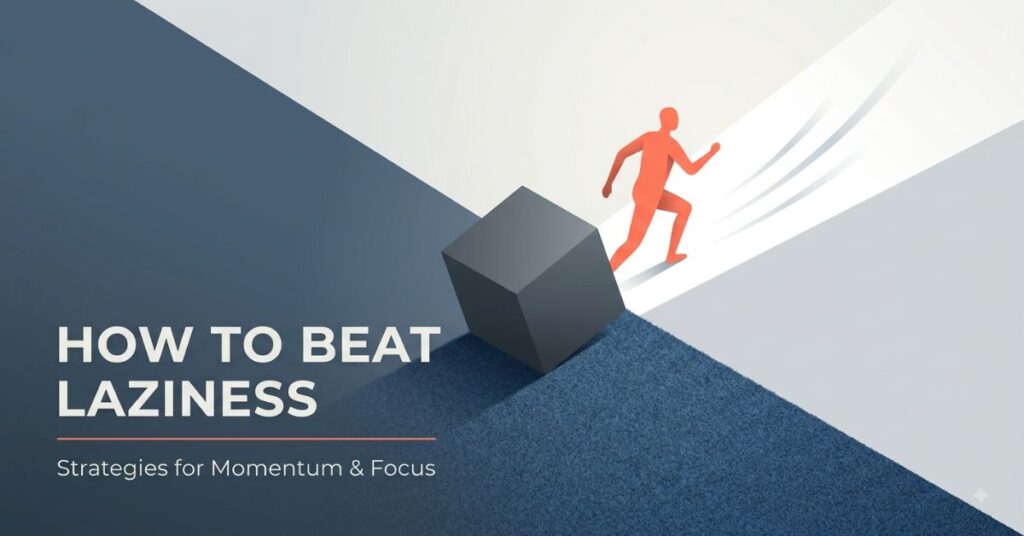
pThe hardest part of any task is starting. The physics concept of static friction applies directly to psychology: objects at rest tend to stay at rest.
To overcome static friction, commit to working on your target task for just 120 seconds. Tell yourself: “I will open the document and write for two minutes. If I want to stop after that, I can.”
Because starting requires the highest expenditure of mental energy, pushing past those first two minutes usually provides enough momentum to continue.
2. Optimize Your Dopamine Environment
Modern environments are hyper-saturated with cheap dopamine: instant notifications, short-form video feeds, processed foods, and high-speed media. When your brain gets easy reward hits all day, standard tasks like drafting a report, reading, or working out feel excruciatingly dull.
- Keep your phone in another room while working.
- Use site blockers to restrict distracting websites.
- Save high-dopamine activities (gaming, social media, TV) strictly for after core work is completed.
By lowering the ambient noise of easy gratification, standard high-value tasks become significantly easier to engage with.
3. Set Micro-Goals Instead of Overwhelming Targets
When a project feels massive—such as “Write a 50-page business plan” or “Clean the entire house”—your brain perceives it as a threat and triggers avoidance.
Deconstruct large objectives into non-intimidating micro-actions:
- Instead of: “Clean the whole house.”
- Try: “Clear off the kitchen counter.”
- Instead of: “Write the entire chapter.”
- Try: “Outline three bullet points.”
Small wins generate dopamine, which creates motivation, driving further action. Motivation follows action; it rarely precedes it.
4. Address Physical and Biological Fatigue
Mental drive cannot override physical neglect indefinitely. Often, what feels like chronic laziness is simply a biological deficit.
Ensure these foundational pillars are solid:
- Sleep Hygiene: Aim for 7–9 hours of quality sleep nightly to restore cognitive executive function.
- Hydration: Mild dehydration directly impairs alertness and processing speed. Drink 16 oz of water immediately upon waking.
- Movement: A quick 10-minute walk boosts blood flow and norepinephrine, sharply elevating mental clarity.
5. Reframe Self-Talk and Eliminate Identity Friction
Labeling yourself “a lazy person” reinforces the very behavior you want to eradicate. Identity drives action. When you internalize a negative label, your brain seeks consistency with that identity.
Shift your focus from identity to environment and systems. Reframe thoughts from “I am lazy” to “My current environment has too much friction, and my step size is too big.”
Active Effort vs. Passive Procrastination: A Quick Comparison
| Metric | Passive Avoidance (Inaction) | Active Momentum (Action) |
| Primary Driver | Overwhelm, fear, low energy | Micro-goals, clear intent, manageable friction |
| Dopamine Source | Cheap inputs (phones, snacks, media) | Completion of real-world tasks |
| Focus Window | Fragmented / Distracted | Single-tasking with clear boundaries |
| Long-Term Result | Guilt, stress, mounting workload | Self-trust, progress, sustained energy |
Real-Life Example: How Small Shifts Overcame Chronic Inaction
Consider Marcus, a remote software developer based in Austin, Texas. Marcus struggled for months to start a side project after finishing his regular 9-to-5 workday. Every evening, he sat on the couch intending to code, but ended up scrolling on his phone for three hours, feeling guilty afterward.
Marcus didn’t need more willpower; he needed lower friction:
- Environment Redesign: He placed his personal laptop open on his desk before leaving for his morning commute, eliminating setup friction.
- Micro-Goal Commitment: He committed to writing just 5 lines of code per night.
- Reward Scheduling: He allowed himself to watch his favorite show only after completing those 5 lines.
Within three weeks, Marcus went from zero progress to working productively for 45 to 60 minutes every evening without relying on raw motivation.
How to Beat Laziness for Long-Term Consistency
Building long-term momentum is about crafting reliable systems rather than relying on fickle bursts of inspiration. Track your daily habits using simple visual tools, protect your early morning hours for deep focus work, and build accountability with peers. When you reduce cognitive friction and take systematic micro-steps, consistency becomes automatic.
4. Key Takeaways
- Laziness is a state, not an identity: It is a temporary signal pointing to friction, low energy, or unclear goals—not a permanent character flaw.
- Action precedes motivation: Do not wait to feel motivated before taking action. Start with a tiny step to generate momentum.
- Lower the activation energy: Use rules like the 2-Minute Rule to bypass initial mental friction.
- Clean up your environment: Remove cheap dopamine sources during focus hours to make real work appealing again.
- Check your physical foundations: Deficits in sleep, hydration, or physical movement frequently present as mental laziness.
5. Expert Tips
- Batch Your Decisions: Plan your daily task list the evening before to eliminate decision fatigue in the morning.
- Use Timeboxing: Allocate strict 25- to 45-minute windows for focused work followed by mandatory 5-minute movement breaks (Pomodoro Technique).
- Implement “Habit Stacking”: Anchor a new, low-friction effort to an established routine (e.g., “After I pour my morning coffee, I will review my top priority for 2 minutes”).
- Create an “Avoidance Inventory”: Write down exactly what you are avoiding and why. Expressing underlying anxiety on paper reduces its emotional charge.
6. Common Mistakes
- Relying Solely on Willpower: Willpower is a finite resource that depletes throughout the day; build supportive systems and environments instead.
- Setting Unrealistically Large Initial Targets: Goal sizes that are too big trigger fight-or-flight avoidance in the brain.
- Confusing Busywork with Meaningful Action: Answering easy emails or reorganizing your desk can feel productive while actually serving as clever procrastination.
- Engaging in Harsh Self-Criticism: Negative self-talk increases emotional stress, which paradoxically leads to more avoidant behavior.
Click here to read The Science of Motivation
7. FAQ Section
Q: Why do I feel lazy even when I get enough sleep?
A: Physical rest is only one component. Mental fatigue, lack of clear goals, emotional stress, or poor nutrition can cause persistent feelings of lethargy.
Q: Is laziness a symptom of mental health conditions?
A: Yes, lack of motivation and persistent low energy are core indicators of clinical depression, ADHD, chronic burnout, and high anxiety.
Q: How does dopamine affect motivation?
A: Dopamine drives anticipation and action. Overexposure to high-dopamine stimuli reduces your brain’s sensitivity, making everyday productive tasks feel unrewarding.
Q: How do I beat laziness in the morning?
A: Expose yourself to bright sunlight immediately upon waking, drink a full glass of water, and avoid picking up your smartphone for the first 30 minutes.
Q: What is the fastest way to get out of a lazy slump?
A: Complete one quick, physical task that takes under 60 seconds, such as making your bed or clearing your desk, to ignite immediate momentum.
Q: Can dietary habits cause laziness?
A: Yes, heavy meals high in refined carbohydrates and sugar cause blood glucose spikes and subsequent crashes that lead to physical lethargy.
Q: What is the 5-Second Rule?
A: It is a technique developed by Mel Robbins where you count down “5-4-3-2-1” and physically move before your brain can negotiate you out of taking action.
Q: How do I help a family member who seems lazy?
A: Offer support without judgment, assist them in breaking large tasks into manageable micro-steps, and check if underlying burnout or stress is present.