
Table of Contents
Ever wonder why you impulsively bought a jacket just because it was marked down from $300 to $100? Or why an argument online made you double down on an opinion you hadn’t even researched?
You like to think of yourself as a perfectly rational thinker. But the human brain takes thousands of mental shortcuts every day to save energy. While these shortcuts kept our ancestors alive, they regularly trick modern minds.
What Are Cognitive Biases?
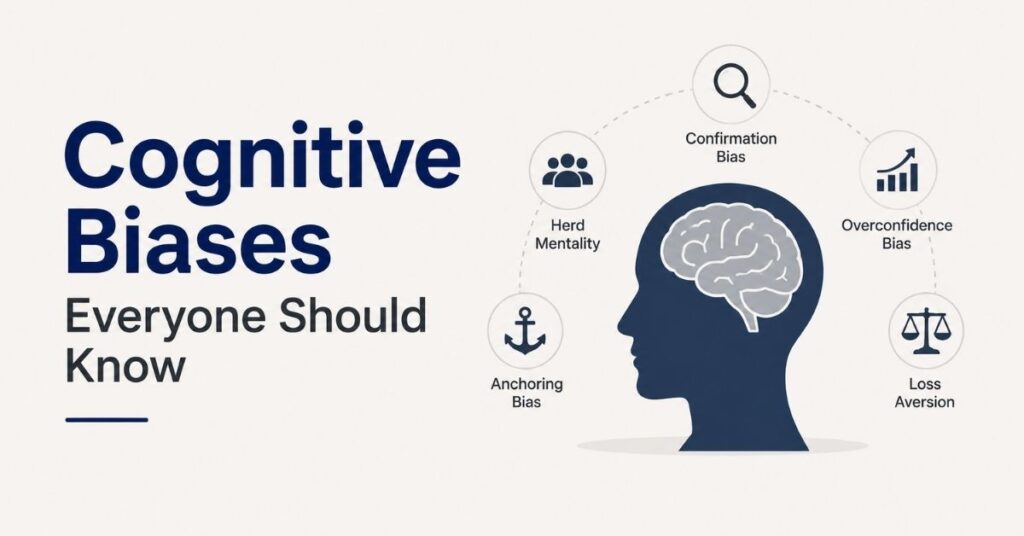
Cognitive biases are systematic patterns of deviation from norm or rationality in judgment. They occur when the human brain attempts to simplify complex information processing, leading to perceptual distortion, inaccurate judgment, or illogical interpretation.
Essentially, they are predictable glitches in human thinking. Understanding these mental traps is the secret to making sharper financial decisions, improving relationships, and unlocking higher critical thinking skills.
Why Understanding Mind Shortcuts Matters in Daily Life
Your brain processes roughly 11 million bits of information per second, but your conscious mind can only handle about 40 to 50. To bridge that gap, your subconscious relies on heuristics—mental rules of thumb.
When a mental shortcut works, it saves time. When it leads to bad decisions, it becomes a bias. Spotting these patterns helps you recognize when emotion or habit is overriding logic.
7 Crucial Cognitive Biases Everyone Should Know
1. Confirmation Bias: Searching Only for Agreement
Confirmation bias is our tendency to search for, interpret, and recall information in a way that confirms pre-existing beliefs while ignoring counter-evidence.
- Real-Life Example: You buy a specific brand of car, and suddenly you notice every positive article about that brand online while ignoring consumer complaints.
- Why It Matters: It traps you in echo chambers, especially on social media feeds tuned to show you what you already like.
2. Anchoring Bias: Falling for the First Price Tag
Anchoring occurs when you rely too heavily on the first piece of information offered (the “anchor”) when making decisions.
- Real-Life Example: A store tags a shirt at $150, then puts it “on sale” for $70. The shirt might only be worth $40, but your brain anchored to $150 and views $70 as a steal.
- Why It Matters: Marketers and negotiators use anchors constantly to skew your perception of value.
3. Availability Heuristic: Overestimating What You Easily Recall
If something can be recalled quickly from memory, you naturally assume it happens frequently.
- Real-Life Example: Hearing intense news coverage about a plane crash makes you afraid to fly, even though driving to the airport carries vastly higher statistical risk.
- Why It Matters: It exaggerates perceived risk and leads to decisions based on media intensity rather than actual statistical odds.
4. Sunk Cost Fallacy: Throwing Good Money After Bad
The sunk cost fallacy drives you to continue an endeavor once an investment in time, money, or effort has been made, even if the current costs outweigh the future benefits.
- Real-Life Example: Finishing an awful 3-hour movie at the theater simply because you paid $18 for the ticket. The money is spent either way—finishing the movie just wastes your time too.
- Why It Matters: It keeps people stuck in dead-end projects, toxic jobs, or failing investments.
| Bias Name | Trigger | Real-World Impact | Quick Defense |
| Confirmation Bias | Seeking comfort in existing views | Ignores facts, creates echo chambers | Actively search for disconfirming evidence |
| Anchoring Bias | Over-relying on initial numbers | Overpaying, poor negotiation | Establish independent value baseline first |
| Sunk Cost Fallacy | Fear of wasting past resources | Trapped in failing projects | Ask: “Would I enter this deal fresh today?” |
5. Dunning-Kruger Effect: The Illusion of Mastery
This cognitive bias occurs when people with low ability at a task overestimate their competence, while genuine experts tend to underestimate theirs.
- Real-Life Example: Watching a 15-minute video on cryptocurrency trading and immediately putting savings into speculative assets because it seems simple.
- Why It Matters: Blind confidence leads to severe errors before genuine skill has time to develop.
6. Framing Effect: How Presentation Controls Your Perspective
People react to a particular choice in different ways depending on how it is presented—such as as a loss or as a gain.
- Real-Life Example: You are far more likely to buy ground beef labeled “80% Lean” than beef labeled “20% Fat,” even though they are identical.
- Why It Matters: It influences political voting habits, medical choices, and daily purchases.
7. In-Group Bias: Blindly Favoring Your Team
In-group bias is the tendency to favor members of one’s own group over those from outside groups.
- Real-Life Example: Giving a job applicant the benefit of the doubt simply because you both attended the same college or support the same sports team.
- Why It Matters: It limits perspective, reduces diversity of thought, and encourages tribalism.
How Cognitive Biases Impact Financial, Personal, and Career Growth
When these biases accumulate, they shape long-term outcomes:
- Financial Health: Anchoring and sunk cost fallacies drain savings accounts through emotional purchases and poor investments.
- Career Advancement: The Dunning-Kruger effect inhibits actual skill building, while confirmation bias keeps professionals repeating outdated industry practices.
- Relationships: In-group bias and framing effect generate misunderstandings, turning simple conversations into heated arguments.
How to Outsmart Your Brain: Practical Steps for Clear Thinking
- Introduce a Strategic Pause: When making big choices, wait 24 hours to let emotional reactions cool down.
- Play Devil’s Advocate: Force yourself to list three logical reasons why your current assumption might be completely wrong.
- Focus on Data, Not Stories: Base decisions on verifiable statistics rather than vivid personal anecdotes.
Key Takeaways
- Cognitive biases are automatic mental shortcuts designed to save energy, but they frequently distort judgment.
- Common traps like Confirmation Bias and Anchoring skew how you process facts and money.
- The Sunk Cost Fallacy tricks you into wasting future resources on past mistakes.
- Recognizing these patterns builds stronger emotional intelligence, sharper critical thinking, and better financial habits.
Expert Tips
- Create a Decision Journal: Write down why you made a big decision, what you expected, and what you assumed. Review it 6 months later to see which biases influenced your choice.
- Reframe Questions Negative-First: Instead of asking “Why is this a good idea?”, ask “How could this plan completely fail?”
- Audit Your Information Diet: Follow reputable experts whose views differ from yours to stretch your thinking past your personal confirmation bias.
Common Mistakes
- Believing You Are Immune: Thinking cognitive biases only affect other people is itself a bias (known as the Blind Spot Bias).
- Overanalyzing Every Micro-Choice: Trying to eliminate all mental shortcuts causes decision fatigue. Save deep critical analysis for high-stakes decisions.
- Confusing Intuition with Expertise: Relying on gut feelings in areas where you lack real experience typically leads straight into the Dunning-Kruger trap.
Click here to read How to Stay Focused
FAQ Section
What is the difference between a heuristic and a cognitive bias?
A heuristic is a mental shortcut used to solve problems quickly. A cognitive bias is the systematic error or poor judgment that occurs when that shortcut breaks down.
Can you completely eliminate cognitive biases?
No, cognitive biases are hardwired into human brain architecture. However, you can learn to spot them and reduce their influence on major decisions.
What is the most common cognitive bias?
Confirmation bias is widely considered the most common, as people naturally prefer information that validates their existing beliefs.
How do cognitive biases affect financial investments?
Biases like anchoring and sunk cost lead investors to hold failing stocks too long or buy overvalued assets based on emotional stories.
What is the Blind Spot Bias?
Blind spot bias is the tendency to recognize cognitive flaws in others while failing to see the exact same biases in yourself.
How does marketing exploit cognitive biases?
Marketers use anchoring with fake discounts, framing with positive messaging, and scarcity cues to prompt rapid emotional purchases.
What is the best way to improve critical thinking?
Regularly seek out opposing viewpoints, pause before major decisions, and base choices on objective data rather than gut feelings.
Does high intelligence protect you from cognitive biases?
No, highly intelligent individuals often use their intellect to rationalize biases more persuasively, a phenomenon known as smart-guy bias.