
Table of Contents
You sit down at your desk with the best intentions. Within ten minutes, you have fourteen browser tabs open, a half-typed email sitting in draft, a Slack notification pinging, and a smartphone buzzing on your desk. You feel incredibly busy, yet by 5:00 PM, you realize you haven’t completed a single meaningful task. Sound familiar?
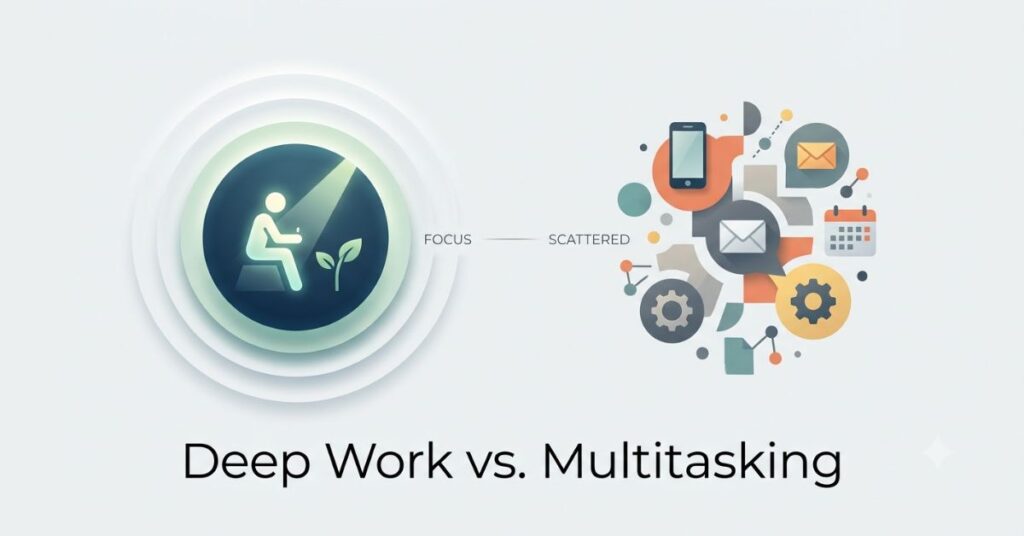
This daily grind highlights the fundamental clash of modern productivity: Deep Work vs. Multitasking.
Deep Work is the ability to focus without distraction on a cognitively demanding task, allowing your brain to synthesize complex information and create high-value output in less time. In contrast, multitasking—or rapid task switching—forces the brain to jump constantly between unrelated activities, reducing cognitive capacity, increasing errors, and creating mental fatigue.
What is the Difference Between Deep Work and Multitasking?
To build a high-performing work routine, you need to understand how these two work styles affect your brain chemistry and overall productivity.
The Mechanics of Deep Work: Single-Tasking for High Value
Coined by Georgetown computer science professor Cal Newport, Deep Work refers to distraction-free concentration that pushes your cognitive capabilities to their limit. When you enter a state of deep work, your brain enters a “flow state.” In this zone, neural pathways strengthen, problem-solving speed increases, and the quality of your output improves exponentially.
Examples of deep work include:
- Writing complex software code or architectural proposals.
- Drafting a comprehensive strategy document or marketing campaign.
- Analyzing large datasets to extract strategic business insights.
The Illusion of Multitasking: Task Switching and Context Penalty
Human brains are not built to process multiple complex tasks simultaneously. When you think you are multitasking—for instance, writing a report while listening to a zoom call and answering emails—you are actually engaging in rapid task switching.
Every time you flip between tasks, your brain pays a “cognitive switch penalty.” Research shows that switching back and forth between activities can destroy up to 40% of an individual’s productive time.
Deep Work vs. Multitasking: A Head-to-Head Comparison
| Feature | Deep Work | Multitasking |
| Primary Focus | Single-task focus | Continuous task switching |
| Cognitive Demand | High energy, deep flow state | Shallow, fragmented effort |
| Output Quality | High value, rare, low error rate | Average quality, higher error rate |
| Mental Energy | Sustainable, long-term focus | Rapid fatigue, burnout |
| Primary Goal | Problem-solving & mastery | Quick execution & inbox clearing |
The Hidden Cognitive Cost of Multitasking
Why does multitasking feel so productive when the results are so poor? The secret lies in a brain chemical called dopamine. Every time you send a quick text, clear an email, or check a notification, your brain receives a micro-dose of dopamine. This creates a reward loop that tricks you into feeling accomplished, even if the work you completed was superficial.
Attention Residue and Brain Drain
When you switch from Task A to Task B, your attention does not immediately follow. A fraction of your mental energy remains stuck thinking about Task A. University of Minnesota professor Dr. Sophie Leroy calls this attention residue. If you check your inbox every 10 minutes while attempting to write a strategy brief, your brain operates with reduced mental bandwidth all day.
The Myth of the Great Multitasker
Many professionals wear their “multitasking ability” like a badge of honor. However, neuroscience studies consistently demonstrate that self-proclaimed heavy multitaskers are actually worse at filtering out irrelevant information, less organized, and less effective at switching tasks cleanly than those who practice single-tasking.
How to Transition from Multitasking to Deep Work in 4 Steps
Switching from a frantic multitasking habit to a structured deep work discipline requires deliberate daily practice.
- Time-Block Your Focus SessionsSchedule 60 to 90-minute blocks in your calendar dedicated exclusively to primary tasks. Treat these blocks like unmissable client appointments.
- Ruthlessly Eliminate Environmental FrictionTurn off push notifications, close unnecessary browser tabs, put your phone in another room, and set your messaging apps to “Do Not Disturb.”
- Establish a Getting-Started RitualHelp your brain transition into deep focus by creating a repeatable pre-work routine: grab a glass of water, clear your physical desk, and set a dedicated visual timer.
- Batch Your Shallow WorkEmails, administrative updates, and chat messages are inevitable. Reserve specific 30-minute windows in the late afternoon to handle all shallow communication at once rather than trickling it throughout the day.
Real-World Scenarios: Deep Work in Practice
- The Software Engineer: Sarah used to answer Slack messages while coding. She frequently introduced bugs and felt exhausted by noon. After blocking out 9:00 AM to 11:30 AM for uninterrupted deep coding, she cut her bug rate by 60% and completed sprint goals two days ahead of schedule.
- The Marketing Strategist: Alex spent his days bouncing between meetings, social media management, and campaign analytics. By instituting a “No-Meeting Wednesday” reserved for deep strategy work, he authored two high-converting campaign proposals in a single month.
4. Key Takeaways
- Quality Over Speed: Deep work yields high-value, creative output, whereas multitasking delivers fragmented, error-prone results.
- Cognitive Tax: Task switching drains up to 40% of your daily productive capacity due to attention residue.
- Habitual Rewiring: Deep work is a trainable skill that requires clear environmental boundaries, time-blocking, and distraction management.
- Shallow Work Batching: Consolidate administrative tasks into dedicated time windows to safeguard your peak cognitive hours.
5. Expert Tips
- Use the 90-Minute Rule: Human focus naturally wanes after 90 minutes. Cap your deep work blocks at an hour and a half before taking a true mental break.
- Define “Done” Before You Start: Clearly state the single deliverable you will complete during a focus block before opening your workspace.
- Keep a Distraction Pad: Keep a physical notepad next to your keyboard. When a random thought or errand pops into your head, write it down and immediately return to your task.
- Track Your Deep Work Hours: Log the number of distraction-free hours you complete each day. Aim for 2 to 4 hours maximum—even world-class experts rarely exceed 4 hours of true deep work daily.
6. Common Mistakes
- Confusing Busyness with Productivity: Checking off 50 low-value shallow tasks does not move the needle on high-impact projects.
- Expecting Instant Mastery: Deep work is a mental workout; your focus muscle will feel tired initially. Start with 30-minute sessions and build up.
- Failing to Inform Your Team: Going dark without communicating your deep work hours can create team friction. Set clear availability expectations with colleagues.
- Taking “Shallow” Breaks: Scrolling social media during a work break keeps your brain stimulated. Instead, take a walk, stretch, or grab a drink of water to truly recharge.
Click here to read Psychology Behind First Impression
7. FAQ Section
What is deep work?
Deep work is the ability to focus without distraction on a cognitively demanding task to produce higher-quality output in less time.
Why is multitasking bad for productivity?
Multitasking forces rapid task switching, which causes attention residue, increases error rates, and reduces productive capacity by up to 40%.
How many hours of deep work can you do a day?
Most adults can sustain between 2 to 4 hours of true deep work per day before experiencing cognitive fatigue.
What is attention residue?
Attention residue occurs when thoughts from a previous task linger in your mind, lowering your focus on a new task.
Can anyone learn deep work?
Yes, deep work is a skill that can be developed through time-blocking, minimizing distractions, and regular mental training.
Is multitasking ever useful?
Multitasking works for combining automatic, low-cognitive physical tasks (like listening to an audiobook while folding laundry), but fails for complex mental work.
How do I stop multitasking at work?
Close extra browser tabs, disable notifications, time-block focus sessions, and schedule specific windows for checking messages.
What is shallow work?
Shallow work consists of logistical, administrative, or non-cognitive tasks like responding to routine emails or updating status boards.